Technical Architecture
Network Topology
The CertChain network runs across 4 OpenShift namespaces, each containing a subset of the Fabric blockchain components and application services.
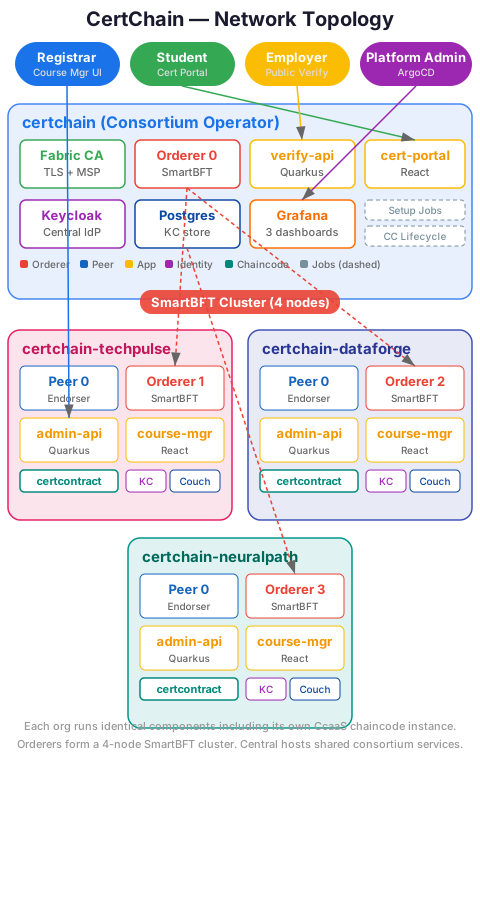
Namespace Layout
| Namespace | Components |
|---|---|
|
Fabric CA, orderer0, cert-portal, verify-api, central Keycloak, Postgres, Grafana |
|
peer0, orderer1, CouchDB, certcontract (CcaaS), Postgres, org Keycloak, cert-admin-api, course-manager-ui |
|
peer0, orderer2, CouchDB, certcontract (CcaaS), Postgres, org Keycloak, cert-admin-api, course-manager-ui |
|
peer0, orderer3, CouchDB, certcontract (CcaaS), Postgres, org Keycloak, cert-admin-api, course-manager-ui |
Technology Stack
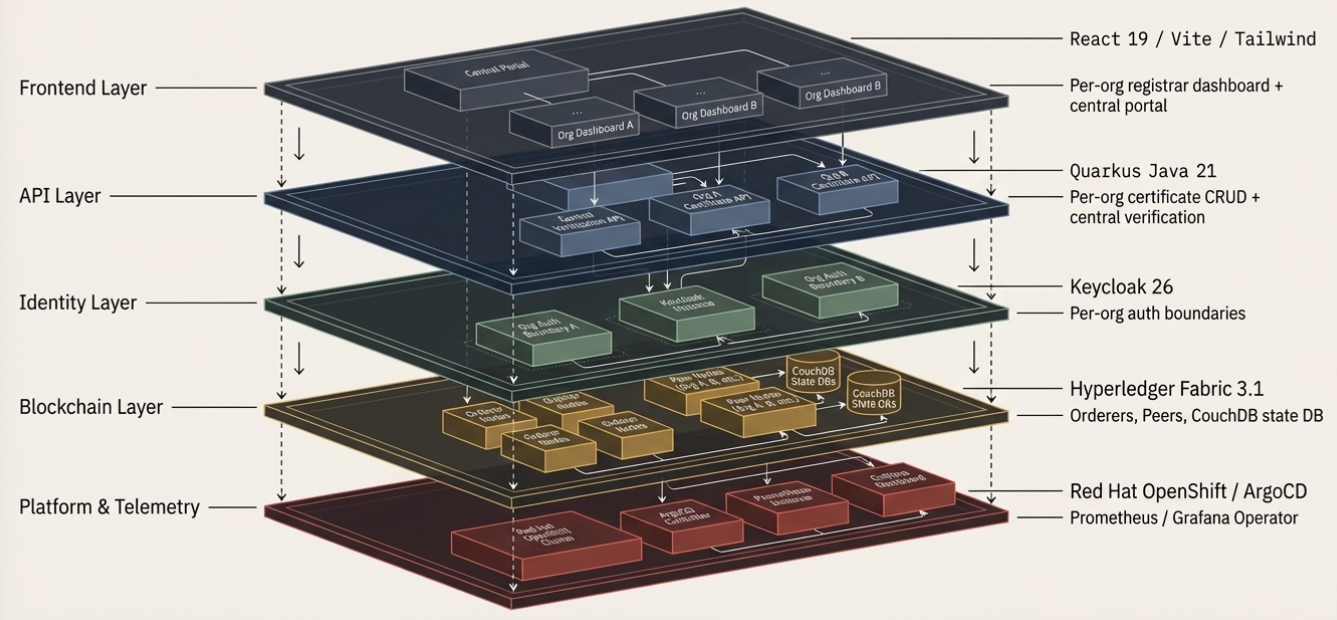
| Layer | Technology |
|---|---|
Blockchain |
Hyperledger Fabric 3.1, SmartBFT consensus, CouchDB state database |
Chaincode |
Go (CcaaS — Chaincode as a Service) |
APIs |
Quarkus 3.x (Java 21) — cert-admin-api, verify-api |
UIs |
React + Vite — course-manager-ui, cert-portal |
Identity |
Keycloak 26 with OIDC, identity brokering, organizations |
Deployment |
Helm App-of-Apps → ArgoCD on OpenShift |
Monitoring |
Prometheus ServiceMonitors + Grafana Operator |
Certificate Lifecycle
Every certificate goes through a well-defined blockchain transaction lifecycle — from issuance through optional revocation.
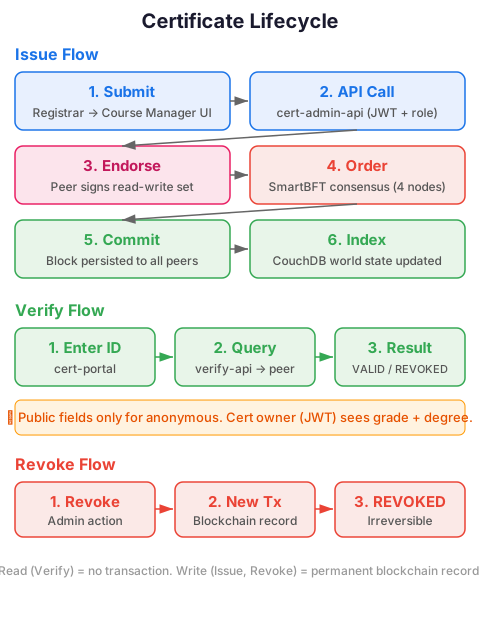
Issue Flow (Write Path)
-
Submit — Registrar fills the certificate form in the Course Manager UI
-
API Call —
cert-admin-apireceives the request with a JWT bearing theorg-adminrole -
Endorse — The Fabric peer simulates the chaincode and signs the proposal (read-write set)
-
Order — The SmartBFT orderer cluster (4 nodes) agrees on block ordering
-
Commit — All peers validate and persist the block to their local ledger
-
Index — CouchDB world state is updated for rich queries
Verify Flow (Read Path)
-
Enter ID — Anyone enters a certificate ID on the cert-portal (no login required)
-
Query —
verify-apievaluates the transaction via the Fabric Gateway -
Read Ledger — The peer reads from CouchDB (no new transaction is created)
-
Result — Returns VALID, REVOKED, EXPIRED, or NOT_FOUND with public fields only
Revoke Flow
-
Revoke — Admin clicks Revoke in the Course Manager (irreversible)
-
New Tx — A new blockchain transaction records the status change
-
Status → REVOKED — All subsequent verifications return REVOKED
|
Revocation is irreversible — the blockchain audit trail is permanently preserved. There is no "un-revoke" operation. |
Public vs Private Data
| Field | Public (anonymous) | Private (cert owner) |
|---|---|---|
Status (VALID/REVOKED) |
✓ |
✓ |
Student Name |
✓ |
✓ |
Course Name |
✓ |
✓ |
Organization |
✓ |
✓ |
Issue / Expiry Date |
✓ |
✓ |
Grade |
✗ |
✓ |
Degree |
✗ |
✓ |
Student ID (email) |
✗ |
✓ |
Privacy enforcement is server-side in the verify-api. The JWT email claim is matched against the certificate’s studentID to determine ownership.
Identity Architecture
CertChain uses a federated identity model with Keycloak identity brokering across organizations.
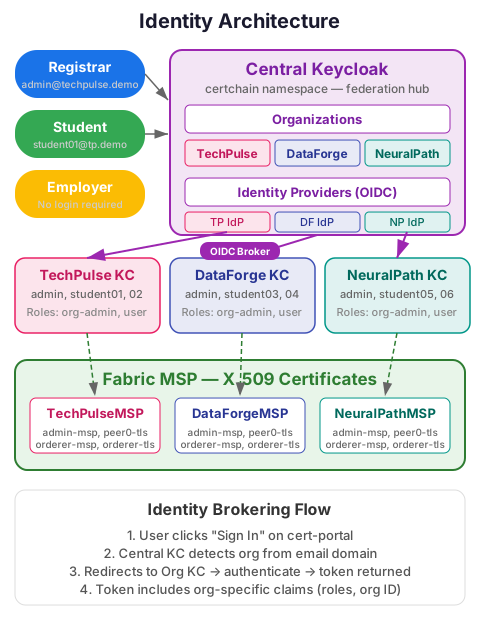
Identity Brokering Flow
-
User clicks Sign In on the cert-portal → redirected to Central Keycloak
-
Central Keycloak shows the organization picker → user selects their org
-
Redirected to the org’s Keycloak instance → authenticates with org credentials
-
Token returned to the application with org-specific claims
Fabric MSP (Membership Service Provider)
Each organization has its own MSP with X.509 certificates:
-
admin-msp — Organization administrator identity (for chaincode operations)
-
peer0-msp / peer0-tls — Peer node identity and TLS certificates
-
orderer-msp / orderer-tls — Orderer node identity and TLS certificates
The Fabric CA in the central namespace issues all certificates for this demo. In a production deployment, each organization would run its own CA for full PKI independence. Each organization’s MSP defines which identities are authorized to submit transactions on behalf of that organization.