Business Context
Why Hyperledger Fabric?
Hyperledger Fabric is a permissioned blockchain platform designed for enterprise use cases where multiple independent organizations need to share data with trust but without a central authority. Unlike public blockchains, Fabric offers fine-grained access control, private data collections, and pluggable consensus — making it applicable to a wide range of business scenarios:
-
Supply chain — track provenance and authenticity across manufacturers, distributors, and retailers
-
Financial services — settle transactions, manage trade finance, and share KYC data across institutions
-
Healthcare — share patient records and clinical trial data across providers while preserving privacy
-
Credentialing — issue tamper-proof certificates that anyone can verify instantly
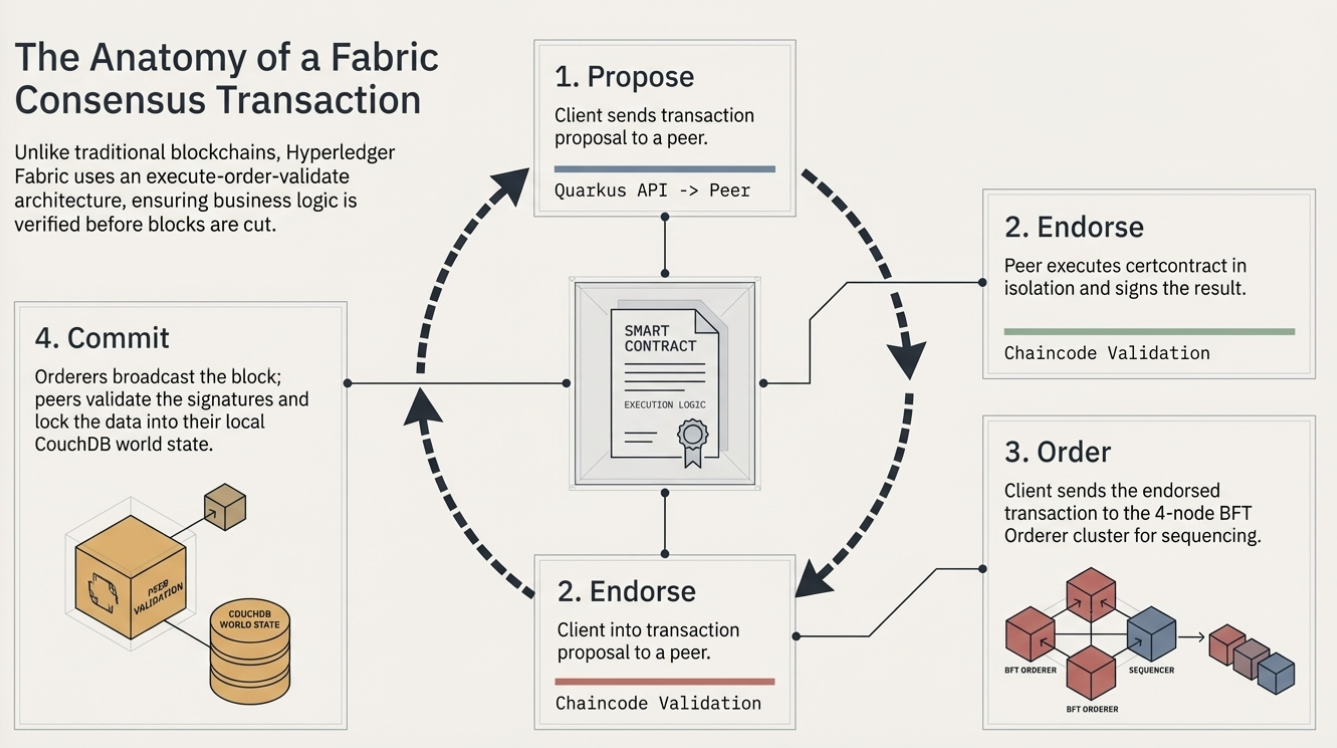
This demo uses course credentialing as a concrete, relatable scenario — but the architecture patterns apply broadly.
Why OpenShift?
Running a multi-org blockchain network in production demands enterprise-grade infrastructure: container orchestration, network isolation, secrets management, monitoring, and automated deployment. Red Hat OpenShift provides all of this out of the box:
-
Namespace isolation maps naturally to Fabric organizations — each org runs in its own namespace with its own RBAC
-
Helm + ArgoCD enables GitOps-driven deployment of the entire network
-
OpenShift Routes expose blockchain services with TLS termination
-
Prometheus + Grafana provide built-in monitoring for all Fabric components
-
BuildConfigs build chaincode and application images directly on the cluster
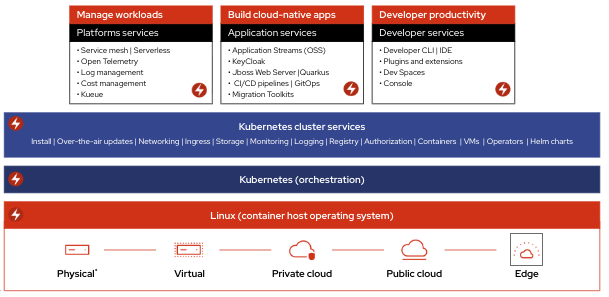
The result: a complete Hyperledger Fabric network deployed and operational in minutes, not days.
The Problem: Credential Fraud
Professional training certificates are easy to forge. A PDF, a stamp, and a logo — and someone has a credential they never earned. Verification is manual and unreliable: employers call training providers, wait for responses, and often just trust the document.
This is a real-world problem for private course organizations — professional training academies, coding bootcamps, certification bodies — that issue thousands of credentials annually. Unlike universities with established registrar offices, these organizations often lack infrastructure for reliable third-party verification.
The Solution: Blockchain-Backed Credentials
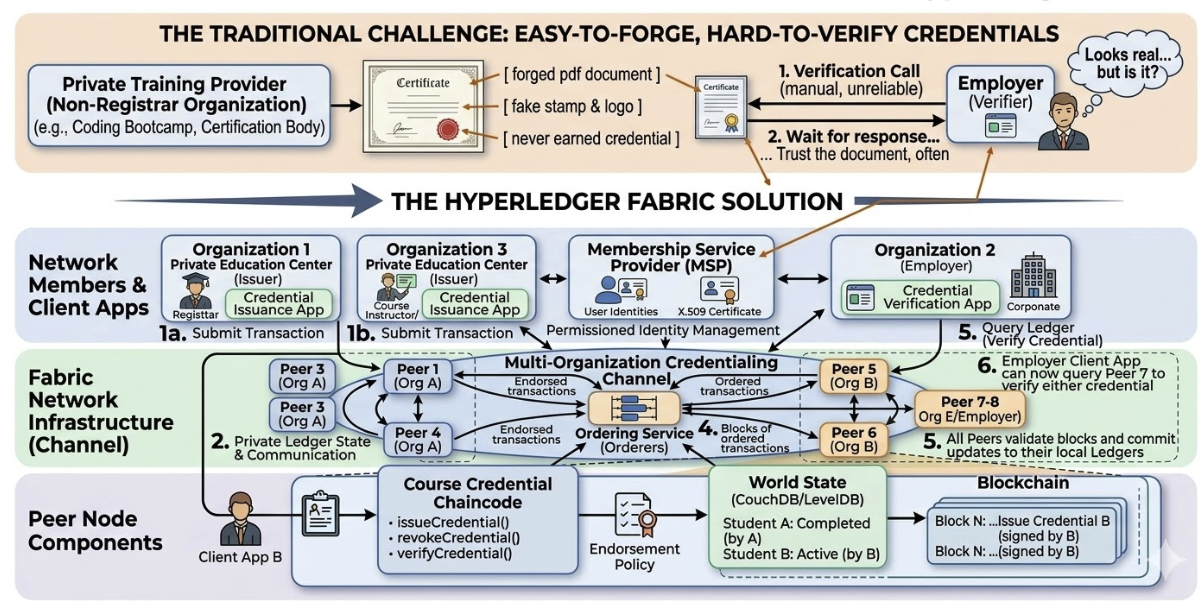
CertChain replaces paper certificates with blockchain-anchored credentials on Hyperledger Fabric. Every certificate is a transaction on an immutable distributed ledger — it cannot be altered, backdated, or forged after issuance.
| Property | How CertChain delivers it |
|---|---|
Tamper-proof |
Certificates are stored as blockchain transactions. Any modification would invalidate the chain. |
Instant verification |
Anyone can verify a certificate in seconds through the public portal — no phone calls, no waiting. |
Privacy-preserving |
Sensitive fields (grade, degree) are visible only to the certificate owner. Public verification shows status and metadata only. |
Decentralized trust |
No single organization controls the ledger. Three independent organizations jointly maintain the blockchain through BFT consensus. |
Auditable |
Every issuance and revocation is permanently recorded with timestamps and organization identity. |
The Demo Scenario
CertChain demonstrates a consortium of three private training organizations that jointly operate a blockchain credentialing network:
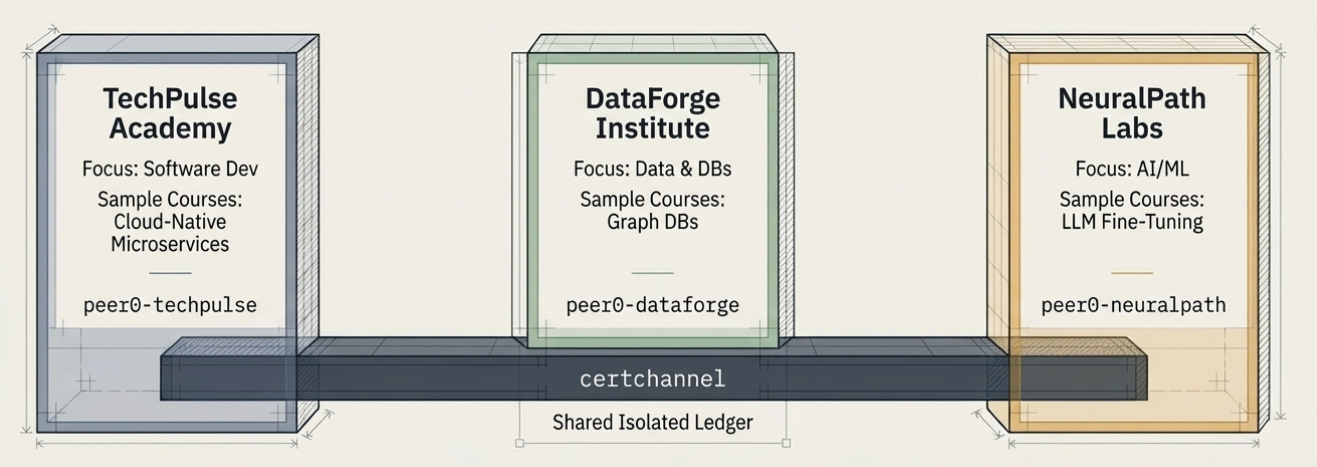
| Organization | Namespace | Description |
|---|---|---|
TechPulse Academy |
|
Full-stack web development and DevSecOps courses |
DataForge Institute |
|
Cloud-native microservices and data engineering |
NeuralPath Labs |
|
AI/ML engineering and deep learning specializations |
Central infrastructure (Fabric CA, verification portal, shared orderer, Grafana) runs in the certchain namespace.
| In this demo, all three organizations run on a single OpenShift cluster in separate namespaces. In a real-world deployment, each organization would typically run on its own cluster (or even its own cloud provider), communicating over the network. The architecture is the same — OpenShift namespace isolation simulates the multi-cluster boundary. |
Three Roles
Registrar (Cert Admin) — A training administrator who logs into their organization’s Course Manager, issues certificates to students, views certificate lists, and can revoke certificates. Each org has its own admin.
Student — A certificate holder who logs into the public Cert Portal to view their transcript and see full certificate details including private fields like grade and degree.
Employer — Anyone who receives a certificate ID from a student and verifies it through the public Cert Portal. No login required — but only public fields are visible.
Why Blockchain, Not a Database?
A centralized database could store certificates — but who controls it? If TechPulse runs the database, why would DataForge or NeuralPath trust it?
Hyperledger Fabric solves this with decentralized consensus:
-
Each organization runs its own peer node and orderer
-
Transactions require endorsement from participating peers
-
The BFT consensus protocol tolerates up to 1 Byzantine (malicious) node out of 4
-
No single organization can unilaterally modify the ledger
This is the core value proposition: trust without a central authority.